
'/%3E%3Cpath%20fill='%23b2b2b2'%20d='M241%20382q0%2016%2017%2026%2017%2011%2042%2011t42-11q16-11%2017-26V269H241'/%3E%3Cpath%20fill='%239f7e00'%20d='M241%20379q0%2014%208%2023%209%209%2021%209%2014%200%2021-9%209-9%209-23V269h-59'/%3E%3Cpath%20d='M241%20339v-70h59v110q0%2014-9%2023l-6%205v-68h-15v72q-8%200-14-4v-68zm59%2040c0%2022%2015%2032%2029%2032%2021%200%2030-18%2030-32v-40h-59'/%3E%3Cpath%20fill='%239f7e00'%20d='M266%20277v5h2v12h-3v-5h2v-5h-9v5h2v5h-4v9h3v18h-5v10h34v-10h-5v-18h3v-9h-4v-5h2v-5h-9v5h2v5h-3v-12h2v-5zm42%20101q0%2010%206%2017%206%206%2015%207%2010-1%2016-7%206-7%206-17v-29h-43'/%3E%3Ccircle%20fill='%230044ad'%20cx='329.5'%20cy='372'%20r='6'/%3E%3Cellipse%20fill='%230044ad'%20cx='300'%20cy='340'%20rx='16'%20ry='21'/%3E%3C/svg%3E)
'/%3E%3C/svg%3E)

There are campaigns that don’t stay on the public space. Brands that decide to invest in high‑impact out of home advertising (OOH) formats —large advertising banners, illuminated light boxes, large-format digital screens— and that, days after installation, find themselves featured in articles in media industry publications, digital newspapers and national media portals.
What do they have in common? They chose Madrid’s transport hubs — such as Avenida de América, Plaza de Castilla and Príncipe Pío — as the platform for their digital advertising messages.
And that stage, by virtue of its physical scale, its traffic and its ability to bring together diverse audiences, turns campaigns into newsworthy stories.
This phenomenon, which industry professionals call earned media amplification, is no coincidence. It follows a very clear logic: when a brand bets on standout creative execution, a spectacular format or a differentiated communications strategy at a point of extremely high visibility, media outlets turn it into editorial coverage.
Advertising stops being just advertising and becomes relevant editorial material about brand trends, creative innovation or brand strategy. Below, we look at some of the most recent cases that prove this.
Coca-Cola and Foster’s Hollywood: when a visual puzzle becomes media coverage
In October 2025, agency McCann launched a campaign for Grupo Alsea celebrating the return of Coca-Cola to Foster’s Hollywood menus after two decades of absence.
The creative concept, with media planning led by Carat (dentsu group), proposed a carefully crafted visual puzzle: the pieces showed what, at first glance, appeared to be the iconic wave of the Coca-Cola logo, but which on closer inspection revealed the chain’s most iconic products: the Black Label ribs, the Director’s Choice burger and the Choco Crunchy dessert.
A campaign that not only played with perception, but invited viewers to pause and actively engage.
The campaign ran across several large‑scale OOH formats at the Avenida de América interchange, one of Madrid’s busiest transport hubs, combining a large banner and the well-known “cubes” — illuminated light boxes with ten advertising faces — in the vicinity of the terminal.
The result was so impactful that Marketing Directo dedicated a full article to the piece under the title “The taste of reunion”, analysing both the creative strategy and the choice of formats.
KFC and Fiesta: light boxes at Avenida de América activated through a child‑inspired execution
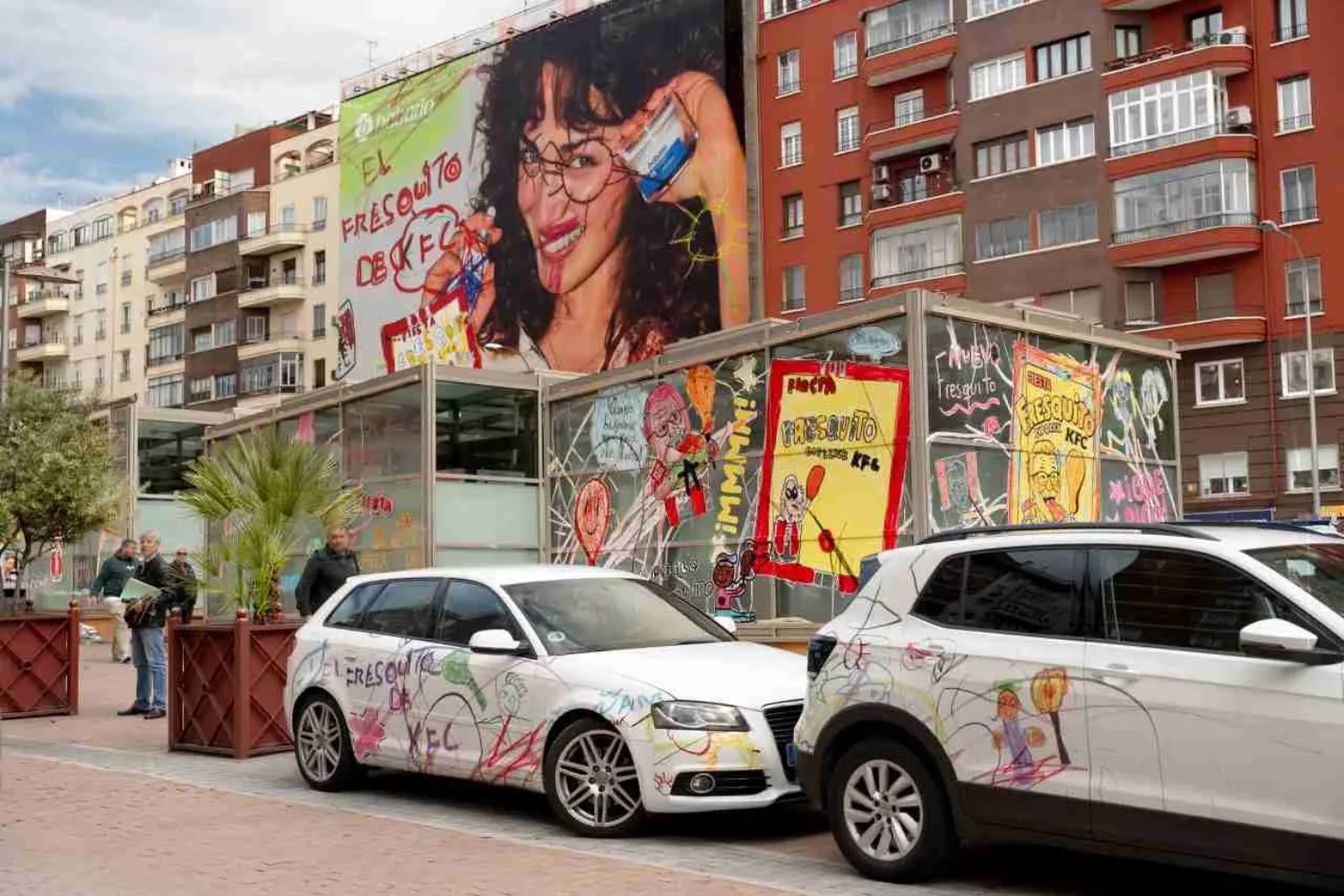
In May 2025, agency PS21 devised an activation for KFC that combined the launch of a special edition Fresquito — a lollipop shaped like a chicken drumstick, created in collaboration with Fiesta — with an experiential creative intervention across various Spectacular Marketing advertising formats.
Seemingly, a group of boys and girls decorated a large advertising banner and several light faces at Avenida de América with Francisco Silvela using crayons and felt-tip pens, in a gesture meant to reflect how young children communicate. “Without being bound by conventional brand codes,” according to Ana Pintané, Senior Creative Copywriter at PS21.
The activation, whose media planning was handled by Arena Media, had a direct impact in the specialist press. Marketing Directo covered the full campaign, highlighting precisely that differentiating element — the intervention on the physical format, which turned a conventional outdoor ad into an widely discussed brand experience.
Magnum Pleasure Express: 3D DOOH at strategic locations that translate into specialist press coverage
The summer of 2024 produced one of the most widely referenced OOH campaigns of the year. Magnum introduced its new Pleasure Express range — featuring the Euphoria, Wonder and Chill flavours — through a high‑impact outdoor advertising activation in 3D DOOH format that dominated the Urban Led screens at Plaza de Castilla itself, at Plaza de la Puerta de San Vicente in Príncipe Pío, and at the corner of Avenida de América and Francisco Silvela in Madrid’s Salamanca neighbourhood, as well as other locations in Spain.
The 3D creative executions recreated an immersive train journey, with imagery designed to generate instant visual impact in passers-by.
The media impact was significant. Publications such as Marketing Directo and IPmark covered the campaign in detail, quoting the words of Almudena Moreno, Brand Manager at Magnum: the brand was seeking to create experiences that went beyond product consumption, appealing to consumers in a highly disruptive and memorable way.
The large-format Urban Led digital screens, generating millions of weekly impressions, became the perfect platform for a proposal that would have gone far more unnoticed on any other format.
Vodafone Hogar 5G: technology in motion at Madrid’s nerve centres
The technology industry has also found in these Madrid locations a powerful ally for campaigns that extend beyond the physical medium. In May 2023, Vodafone and its agency iProspect (dentsu) launched their Hogar 5G product campaign with a bold audiovisual OOH strategy: 3D pieces produced by Sra. Rushmore were deployed simultaneously at Príncipe Pío, Avenida de América, Plaza de Castilla and other strategic areas of Madrid.
The coordination of multiple media owners and the adaptation of the message to so many formats across the same city was explicitly highlighted by Vodafone Spain’s brand director.
The campaign earned coverage in Marketing Directo, which underscored precisely this capacity of spectacular OOH to “make an impact in a prominent, visible and distinctive way” — in the company’s own words — and to generate an earned media amplification effect that digital or television alone would not have achieved with the same intensity.
Salamanca touches the sky: 120 mupis and 9 screens that reached media across all of Spain
Tourism institutions have also discovered the power of Madrid’s interchange transportation hubs to reach their target audience — and, along the way, earn earned media coverage.
In March 2025, Salamanca City Council launched the “Salamanca toca el cielo” (“Salamanca Touches the Sky”) campaign — a network of 120 mupis and 9 digital screens deployed for two months across the Avenida de América, Plaza de Castilla and Príncipe Pío transport hubs, among others, with the goal of attracting Madrid-based tourists, who account for 20% of the city’s domestic visitors.
The campaign received extensive coverage from Cadena SER, La Gaceta de Salamanca and Salamanca al Día, all of which highlighted the audience figures for the formats. At Plaza de Castilla alone, they generated 49.4 million impressions.
Palencia: 24 square metres at Plaza de Castilla that reached radio and digital media
At the end of 2025, the Palencia Provincial Council invested in a 24-square-metre vinyl at the Plaza de Castilla interchange to position the province as a disconnection destination under the slogan “Si necesitas parar, bájate en Palencia” (“If you need to stop, get off at Palencia”).
The campaign, which ran until January 2026 to coincide with FITUR, was presented by the Council’s own president during her personal visit to the formats in Madrid. The institutional gesture of physically visiting the banner and sharing it publicly further amplified the media resonance.
Outlets such as Cadena SER, El Español and regional tourism portals covered the campaign, underlining the capacity of the Plaza de Castilla interchange — Madrid’s third busiest, with 8.6 million travellers in the first half of 2024 alone — to generate millions of impacts and turn a local action into a nationally relevant news story.
Fuerteventura on the platforms of Príncipe Pío: Jandía’s beaches travel to the Metro
In October 2025, Pájara Town Council (Fuerteventura) deployed a campaign at the Príncipe Pío interchange, alongside 50 branded taxis and a wrapped bus, to promote Jandía’s beaches to Madrid audiences.
The initiative, which combined large-format advertising at the interchange with a mobile presence on the capital’s streets, was covered by Canarias7, which highlighted the strategic value of Príncipe Pío as an arrival point for interurban and commuter transport users, as well as its high pedestrian footfall.
Pájara’s Tourism Councillor put it plainly: the campaign responded to the need to consolidate the destination at a national level and reinforce Fuerteventura’s presence in one of the main domestic tourist source markets. The choice of this Spectacular Marketing format, at the entrance to the Príncipe Pío interchange with its more than 30 million monthly impacts, was the factor that turned a local promotional action into a newsworthy story for the Canary Islands.
CleceOOH’s Madrid locations: drivers of cross‑media visibility
Why do these specific formats have this capacity to generate earned media exposure?
- The first reason is scale: millions of weekly impressions that turn any campaign into a high‑reach media event.
- The second is audience quality.
- The third, and perhaps the most decisive from a media perspective, is that large‑format displays at these locations are, by their very size and visibility, inherently media‑friendly.
Spectacular-format outdoor advertising campaigns have evolved. It is no longer simply about a brand appearing before the greatest possible number of eyes. It is about that appearance being so relevant, so surprising or so well placed that the media themselves choose to tell the story.